Showing posts with label cooking. Show all posts

Sunday, April 3, 2011

One Last Gingerbread


It snowed again. I couldn't believe that one. I had to go digging in the back of the coat closet to find my Sorrel boots and ski gloves so that I could go outside and shovel. I swear to God I've shoveled enough snow this winter to cover a small state, like Rhode Island or West Virginia. So you can imagine my frustrated surprise and smoldering anger as I banged around the basement trying to remember where I had put the snow shovels. Of course I've already planted the peas and fava beans, which should both be fine. But the patch of spring mesclun mix that's just beginning to germinate-is that going to make it? I'm about to fly into a gardener's rage. Are gardeners supposed to fly into rages? I'll wind up in gardener's anger management:

"My name is Michael and I began yelling at the garden in 2011. No, wait–it was 2010 with the Japanese garden beetles and the cut-worms. Or was it 2009 and the lead-contamination in the soil?" Then an elderly lady in a wide-brimmed straw hat and canvas tool-apron leans over and gives me a long, firm hug of support.

If it's going to keep snowing then I'm making gingerbread and that's all there is to it. I've got all these apples left over from a photo shoot, so it's going to be an apple-ginger bread. Try and stop me.
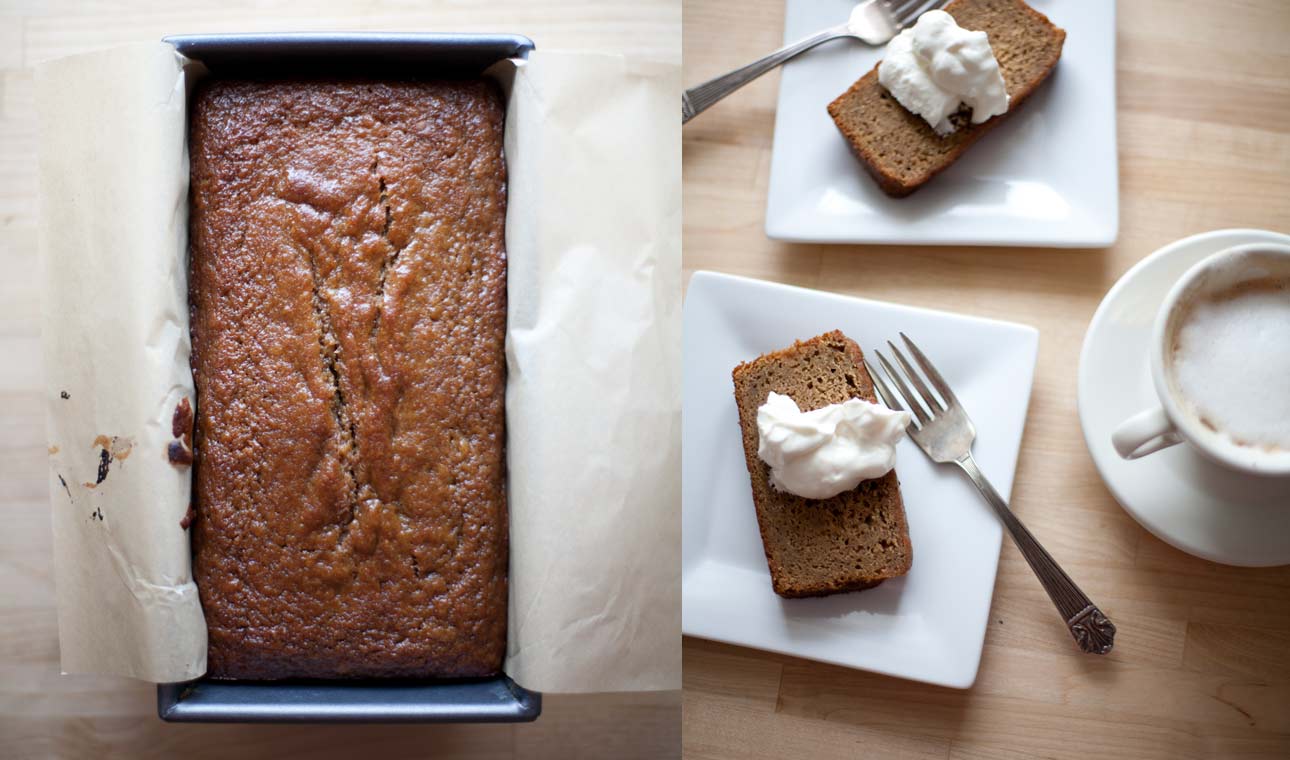


Apple-Ginger Bread
adapted from Martha Stewart's Baking Handbook

1/3 cup sugar
1 1/2 pounds (about 4) apples, peeled, cored and cut into chunks
2 teaspoons fresh lemon juice

2 sticks (1 cup) unsalted butter @ room temperature
3 1/4 cups all-purpose flour
2 teaspoons baking powder
1/2 teaspoon baking soda
1/2 teaspoon salt
1/2 teaspoon ground cinnamon
1/4 teaspoon ground allspice
1/4 teaspoon ground ginger
1 tablespoon micro-planed fresh ginger
1/2 cup milk
1 teaspoon pure vanilla extract
1/4 cup molasses
4 large eggs

In a medium saucepan, combine the 1/3 cup sugar, lemon juice and apple chunks and cook over medium heat until the apples break down (5-10 minutes). Cover and continue to cook another 5 to 10 minutes until the whole thing looks like applesauce. Let cool.

Preheat the oven to 350˚

Butter 2 loaf pans and line with parchment paper.

Into a medium bowl, sift together the flour, baking powder, baking soda, salt and all the dry spices.

Into a small bowl, combine the milk, vanilla.

In the bowl of an electric mixer fitted with the paddle attachment, beat the butter, 1 3/4 cups sugar, molasses and fresh ginger on medium-high speed until light and fluffy, scraping down the sides as needed. Add the eggs, one at a time, beating for 1 minute after each addition.

With the mixer on low speed, add the flour mixture in three parts, alternating with the milk mixture; beat until just combined after each addition, being careful not to overmix. Add the applesauce and mix to combine again.

Divide the batter between the two loaf pans and bake until a skewer or cake tester comes out clean - approximately 45 minutes to an hour. Cool on a wire rack for 20 minutes and then run a knife around the edges and invert the pans to release the loafs. Let the loafs cool completely before slicing (if you can wait).


Saturday, December 25, 2010

Christmas Cookies


At some point in my early adulthood I decided there were several things that I needed to start gathering from my grandparents' generation before it was too late – in no particular order, the negatives of old family pictures, tea cups and Sicilian cookie recipes. The negatives turned out to be easy - both grandmothers and a couple of aunts had surprising stashes and were happy to let me take them. The tea cups I'll leave for another time. It's the cookies that interest us here.

For me, no childhood memory of family holidays is complete without homemade Sicilian cookies – sesame cookies (good for dunking in coffee), spiced chocolate balls, the strange and mysterious anise-flavored "bones of the dead," and the glorious and glorified Cuccidatti (think fig newton for grownups.) When I started making these cookies myself, it was usually during the Christmas holiday season when I had the time and the inclination.
Over the years I have come to associate all of these Sicilian cookies with the holidays but in reality only the Cuccidatti are traditionally served during Christmas.

Nothing sums up the history of Sicily quite like a Cuccidatti. The mash-up of figs and raisins and chocolate and citrus represent all the occupiers, conquerors and rapists
who have spent any appreciable time on the island – the Greeks, the Romans, the Arabs, the Spanish. They're all there, wrapped snugly in cookie dough and sweetly drizzled with icing.


Cuccidatti
modified and adapted from Gourmet magazine

These cookies can be quite heavy (and in Sicily quite sweet) so over the years I've tried to lighten them up a bit. I'll use white figs (Calimyrna) in equal proportion to black figs (Mission) or substitute dried apricots for some of the black figs. I've seen recipes that won't say to chill either the filling or the dough but I think both are a good idea - the filling should have time to come together and the butter-dough should chill and set. Make them in the evening and then let it all sit overnight in the fridge.

Filling

4 oz almonds - toasted

3 oz pine nuts - toasted

4 oz Calimyra figs (or dried apricots)

4 oz Mission figs

4 oz golden raisins

zest of half a lemon

zest of half an orange

1 tablespoon cinnamon

1/2 teaspoon cloves

2 oz dark chocolate

3/4 cup honey
1/4 cup brandy (or grappa)


Put everything in a food processor and pulse until it's broken up and more or less uniform but not whizzed into a paste - you should be able to make out bits of nuts and chocolate etc. Refrigerate overnight or at least 8 hours covered in plastic wrap.


Dough

4 cups flour
1 cup + 1 tablespoon sugar

1 tablespoon baking powder

1 teaspoon salt

2 sticks (1 cup) unsalted butter - cubed

2 large eggs

1/2 cup whole milk

1 1/2 teaspoons vanilla

zest of half a lemon
zest of half an orange


Put all the dry ingredients in a food processor and pulse to mix. Add the cubed butter and pulse again until the butter is roughly pea-sized. Empty into a large mixing bowl. Combine the liquid ingredients into the food processor and mix. Add the liquid mix to the dry ingredients and stir with a fork until everything starts to come together. Switch to your hands and quickly knead it all together. Cut in half and form each half into a thick, rough, rectangle shape. Wrap in plastic and refrigerate overnight, or at least 8 hours.

Making the cookies
Preheat the oven to 350˚

Measure 1/3 cup of the filling at a time and roll into logs about an inch wide and 10 inches long. The filling is quite sticky and a little hard to work with, so a tiny bit of flour on your hands can help. I've taken to using plastic wrap and my sushi roller and just squeezing the 1/3 cup of filling to the width of the bamboo roller.

Working with one piece of dough at a time (leaving the other in the refrigerator) roll into a 15"x14" rectangle, an 1/8" thick. With a ruler or straight-edge trim to 13"x10", then cut into 4 (10"x 3 1/4") strips. Lay a log of filling in the middle of each strip and then bring up the dough on each side and pinch the seam together. Roll the log over, seam side down, and press gently, flattening it slightly. Cut the log into 1 1/2 - 2 inch cookies with a sharp, floured knife and then arrange on a large baking sheet lined with parchment or a Silpat mat.

Bake in the middle of the oven for 15-20 minutes, until lightly golden around the edges. Transfer to cooling racks for at least 10 minutes before icing.

Repeat with the remaining dough and filling.

Icing
1 cup confectioners sugar
1/2 teaspoon vanilla

1 1/2 - 2 tablespoons lemon + orange juice (you didn't throw them away after zesting, did you?)
sprinkles (more or less depending on the degree of your inner child)

Whisk together the sugar and vanilla with enough citrus juice to make a thick, pourable icing. Drip the icing onto the warm cookies and shake those sprinkles. Let cool and store in an airtight container. Alternatively you could pour yourself a mug of coffee and consume the entire batch standing at the counter.

Saturday, October 16, 2010

Achilles and Kale


There is a Chinese aphorism—at least I think it’s Chinese, it could be eastern-European gypsy for all I know—that goes something like, “A successful thief does not look like a thief”. Which leads directly and obviously to a question that has been bugging me for a little while, “What the hell do you feed a two-year old?"


I worked on a children's cookbook several years ago and the constant refrain from the Art Director was, “foods can’t touch each other.” As I obediently complied with this directive, I thought silently to myself, “Sadie will never take such a ludicrous attitude (I believe she was still breastfeeding at the time.) Real food touches and my child will eat real food!"


So here we are in the terrible twos and I get this fairly often: head turned slightly to the side, eyes closed to the offending plate, and with a haughty sweep of her arm, she pushes the plate to edge of her high-chair tray. And just in case I’m still unclear, she punctuates it with a simple and disdainful, “no!" Or just dumps it on the floor.


Now the only strategy that a parent finds readily at hand is what I’ll call the Separation & Confinement Policy. The basic metaphor is the wall (much like the United States’ Immigration policy along the Mexican border. Or Palestine, say. Or post-war Berlin.) Kids' plates in the store are steeped in the policy – little Berlin walls separating one part of the plate from the others, so that little Timmy’s peas don’t touch his mac-and-cheese which in turn doesn’t touch his chicken nuggets—fundamentally a TV-dinner. Or astronaut food.


But I’ve found myself yearning for a different policy, something that would turn the tables and put me back in charge of my two-year old's eating habits. I’m the man of house for god’s sake. I AM PAPI-WHAPI!


And so I’ve come up with what I call the Integration & Obfuscation Policy (sort of like forced busing or Beirut in the old days.) The metaphor here would be the Trojan Horse. The whole objective of the Integration & Obfuscation Policy is to render the child’s meal completely unrecognizable as to both form and content. I’ve found that her ability to exercise autonomous will hinges on the ability of her tiny brain to identify what’s in front of her. Remove her ability to identify say, kale, because it’s hidden inside a frittata, and she’ll happily shove cube after cube into her grinning little face. That rice she wouldn’t eat last night and is currently in a tupperware container in the back of the fridge—throw that in too. Day-old peas—absolutely. A leftover drumstick—certainly. You get the idea.


All you need is a food processor to whiz things beyond recognition and enough egg to bind it all back together. There is simply no end to what you can put in a frittata.


Then again, it may be the ton of cheese I slip into the recipe or the mountain of ketchup I put on the side, which she greedily “dips." Maybe the Integration & Obfuscation Policy isn’t all that it’s cracked up to be.


Savory Kale Tart
Adapted from Bistro Cooking, by Patricia Wells


I know I was talking about frittata, but this tart is nothing more than a frittata in a pasty shell. I'll make it from scratch and we’ll have it for dinner with a salad. Frittata is more of a leftovers affair. Patricia’s recipe uses Swiss chard although I tend to use kale, but any leafy green will work. The great thing about this recipe is that the pastry uses olive oil instead of butter so there are no tricky methods or refrigerating.


Pastry
1 cup (140g) all-purpose flour
¼ teaspoon salt ¼ cup extra-virgin olive oil
¼ cup water

Filling
1 pound (500g) kale
Salt and freshly ground pepper
4-5 large eggs
1 cup (100g) grated Parmesan cheese

Preheat the oven to 400˚


Combine the flour and salt in the bowl of a food processor and then blend in the water and oil. It should form a wet crumble. Dump the pastry into the center of a 10 ½ inch tart tin or dish. Form it into a ball and then press it out into an even layer. I usually press it up the sides of my tart dish, but I don’t know that it’s necessary.

Remove most of the hard stem from the kale and then roughly chop into 2 or 3 inch ribbons. Wash but don’t spin or dry the kale. In batches, coarsely chop the kale in the food processor.
Saute the kale in a large pan with a little oil and salt and pepper until the moisture has evaporated.

Combine the eggs and cheese in a medium bowl and mix until thoroughly blended. Mix in the kale. Pour into the pastry shell and bake for 40 minutes or until the filling is firm and has browned a little on the top.

Saturday, October 9, 2010

Great for Children


When summer finally begins to turn to fall in New England and the evenings start to cool and you begin to catch the faint odor of wet leaves and wood fires, it's time for apple picking. So last Saturday morning we packed Sadie into the car and set out through the crisp, bright morning in high spirits and eager anticipation, the child chanting "apoo pickin'" from the back seat. We were something out of a Martha Stewart dream.


We had decided to forgo the simple apple farm we usually go to in favor of a place recommended by friends (who also have small children) as a place "great for kids". Was there a faint warning in the promise of hay rides? Or the barnyard animals? Heedless, we drove on towards our destination with fun.


Surely when we were greeted at the parking area by a platoon of parking attendants, equipped with safety-vests and walkie-talkies, directing us to the far end of a giant field, past the five empty school buses - surely then we should have known what were getting in to. Or when we realized we didn't have the $30 in cash for the two tiny bags we could fill to our hearts content. Or when we had to beg our way onto the hay ride because we had failed to buy tickets, in order to get to the ATM at the other end of the farm … surely then.


No, the totality of the theme-park nightmare that we had stumbled into didn't completely hit me until I encountered the jumbo-inflatable-kiddie-jump-o-rama; then I knew.


It took us nearly an hour and a half before we were actually in an orchard picking apples. By now we regretted not bringing Sadie's lunch (although she was blissfully overdosing on cider donuts) and I lacked the enthusiasm to even fill our two little bags. We simply evacuated before one of us had a melt-down (I was the closest.)


What's a parent to do? Why, make rustic apple tarts of course.


2 little Rustic Apple Tarts

This is about the simplest tart you can imagine and I've always had the impression it's pretty hard to screw up. I've kept it to just apples and spices, but any number of things can be added: raisins or currents, cranberries, raspberries, pears, quince. The only two caveats I would make are; keep the dough cold (refrigerate for at least an hour after mixing) and let the apples macerate for a good 10 minutes before assembling the tarts to let them throw some juice. The technique for the dough may seem a little screwy, but I think I got the basic idea from Jacques Pépin or Julia Child many years ago - so there.

Filling
5 medium-sized apples
3/4 cup of sugar
1 teaspoon cardamom
1 teaspoon allspice
pinch of salt
a few twists of black pepper
zest and juice of 1 lemon
2 tablespoons of calvados (or brandy)

Crust (a recipe and a half)
2 1/4 to 2 1/2 cups (240g) of all-purpose flour
10 - 11 tablespoons (160g) of unsalted butter - cubed
3 teaspoons of sugar
1/4 teaspoon salt
enough ice-water to bind the dough

For the dough: combine the flour, salt and sugar in food processor and completely pulse in half the butter. Add the remaining butter and drizzle the ice-water, pulsing as little as possible to get the dough to just ball up (the objective being to keep the remaining butter from being completely processed). Quickly form into a ball and wrap in plastic and refrigerate for at least an hour.

Meanwhile, peel and core the apples and cut them into whatever size dice you prefer. Zest and squeeze the lemon onto the diced apples. Add all the sugar, spices and calvados and stir it up good. Stir it periodically over the next 5 or 10 minutes. It should throw a fair amount of juice which I think helps to cook the apples later.

To assemble the tarts, cut the dough in half and roll out two crusts (approximately 1/8 to 1/4 inch thick - I like the crust a little on the thick side for these tarts) and one at a time place them on baking sheet lined with parchment. Spoon in a generous amount of apples and juice into the middle of the crust, leaving a couple of inches of dough on the edges. Then, quick before the juice runs all over the place, fold over the outer edge, crimping as you go. Brush with some of the remaining juice.

Pop into a 350˚ pre-heated oven for about 45 minutes or until the tops of the crust and apples are a nice, dark, golden-brown.


Tuesday, September 28, 2010

Tomato Tart


Drowning in cherry tomatoes. Back in July, the plan had been to stick with smaller, more salad-friendly varieties because I wasn't sure how much time and energy I would have for stewing, jarring and preserving. Now, after what seems like weeks of tomato-basil-balsamic salads, it's time for something a little different.

There was some cream and ricotta in the 'fridge left over from the weekend and I thought there must be some kind of Provencal-style tart-thing in all that. So while that's all kicking around in the back of my head, I'm thumbing through my recently arrived copy of Breakfast, Lunch, Tea, and there it is:


Ricotta, Tomato and Thyme Tart
Adapted from Breakfast, Lunch, Tea by Rose Carrarini

cherry tomatoes (enough to fill a 10 inch tart tin)
salt and ground pepper
100g (1 cup) grated Cheddar or similar cheese
1 blind-baked tart shell (10 inch)

Cream Mixture
1 cup heavy cream
1 cup ricotta
4 eggs
pinch of salt and pepper
pinch of ground nutmeg
2 tablespoons of chopped fresh thyme

Preheat the oven to 350˚.

While you're blind-baking your tart crust (whatever recipe you like or use), spread the tomatoes out on a baking sheet lined with parchment and bake for about 45 min or until the tomatoes have shriveled and lost some of their liquid.

Scatter the cheese over the base of the tart crust and then spread the tomatoes on top of that. Pour the cream mixture as high as you can without spilling over the crust.

Transfer carefully to the oven and bake for about 30 minutes until the filling has set and is lightly golden.